
اب سے ہم Elev8 ہیں
ہم صرف ایک بروکر نہیں ہیں۔ ہم ایک جامع ٹریڈنگ ایکوسسٹم ہیں—ہر چیز جو آپ کو تجزیے، ٹریڈ اور ترقی کے لیے درکار ہو، ایک ہی جگہ پر ہے۔ کیا آپ اپنی ٹریڈنگ کو بلند کرنے کے لیے تیار ہیں؟
ہم صرف ایک بروکر نہیں ہیں۔ ہم ایک جامع ٹریڈنگ ایکوسسٹم ہیں—ہر چیز جو آپ کو تجزیے، ٹریڈ اور ترقی کے لیے درکار ہو، ایک ہی جگہ پر ہے۔ کیا آپ اپنی ٹریڈنگ کو بلند کرنے کے لیے تیار ہیں؟
Gold (XAU/USD) rebounds swiftly from over a two-week low, around the $3,324-3,323 area touched during the Asian session on Monday, and touches a fresh daily top in the last hour. The growing acceptance that the US Federal Reserve (Fed) will resume its rate-cutting cycle in September triggers a fresh leg down in the US Treasury bond yields. This, along with some repositing trade ahead of US President Donald Trump's meeting with Ukrainian President Volodymyr Zelenskiy and European leaders to discuss a peace deal with Russia, offers some support to the safe-haven bullion.
Meanwhile, the US Dollar (USD) ticks higher amid diminishing odds for a more aggressive policy easing by the Fed, which might keep a lid on any meaningful appreciating move for the non-yielding Gold. Apart from this, the prevalent risk-on mood warrants some caution for the XAU/USD bulls. Traders might also opt to wait for more cues about the Fed's rate-cut path before placing fresh directional bets. Hence, the focus will remain glued to the release of the FOMC Minutes and Fed Chair Jerome Powell's speech at the Jackson Hole Symposium during the latter part of the week.
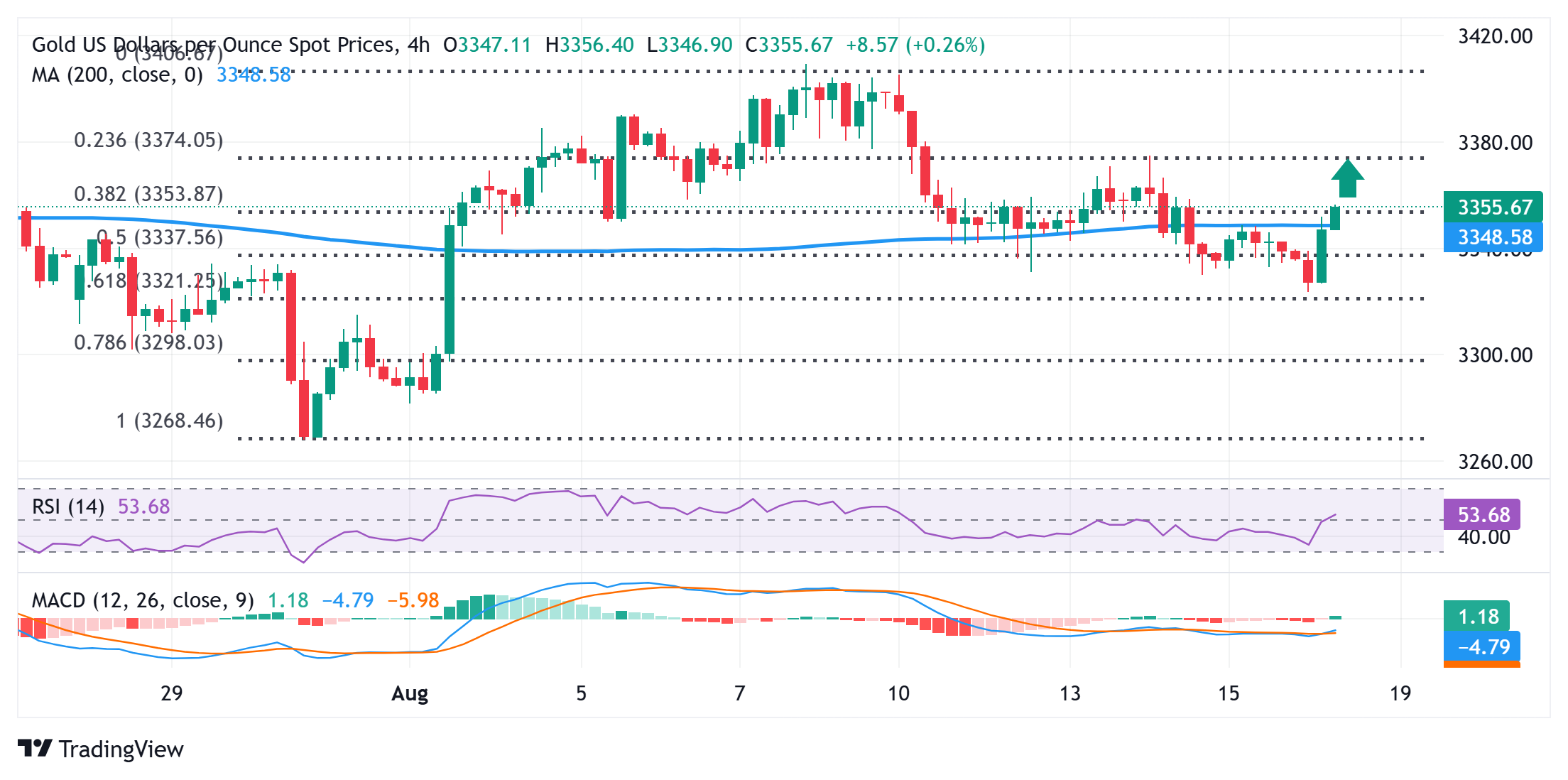
An intraday bounce from the 61.8% Fibonacci retracement level of the upswing from the July monthly low and a subsequent move beyond the 200-period Simple Moving Average (SMA) on the 4-hour chart favor the XAU/USD bulls. Moreover, oscillators on the said chart have again started gaining positive traction and back the case for a further intraday appreciating move. Some follow-through buying beyond the $3,355 area, or the 50% retracement level, will reaffirm the positive outlook and lift the Gold price to the next relevant hurdle near the $3,372-3,374 region, or the 23.6% Fibo. retracement level. The momentum could extend further and allow the commodity to reclaim the $3,400 mark before aiming to test the monthly peak, around the $3,408-3,410 area.
On the flip side, the 200-SMA on H4, around the $3,346 region, now seems to protect the immediate downside ahead of the $3,324-3,323 zone, or the 61.8% Fibo. retracement level. Failure to defend the said support levels could make the Gold price vulnerable to weaken further towards the $3,300 round figure en route to the $3,283-3,282 horizontal zone and the $3,268 region, or the late June swing low.
Gold has played a key role in human’s history as it has been widely used as a store of value and medium of exchange. Currently, apart from its shine and usage for jewelry, the precious metal is widely seen as a safe-haven asset, meaning that it is considered a good investment during turbulent times. Gold is also widely seen as a hedge against inflation and against depreciating currencies as it doesn’t rely on any specific issuer or government.
Central banks are the biggest Gold holders. In their aim to support their currencies in turbulent times, central banks tend to diversify their reserves and buy Gold to improve the perceived strength of the economy and the currency. High Gold reserves can be a source of trust for a country’s solvency. Central banks added 1,136 tonnes of Gold worth around $70 billion to their reserves in 2022, according to data from the World Gold Council. This is the highest yearly purchase since records began. Central banks from emerging economies such as China, India and Turkey are quickly increasing their Gold reserves.
Gold has an inverse correlation with the US Dollar and US Treasuries, which are both major reserve and safe-haven assets. When the Dollar depreciates, Gold tends to rise, enabling investors and central banks to diversify their assets in turbulent times. Gold is also inversely correlated with risk assets. A rally in the stock market tends to weaken Gold price, while sell-offs in riskier markets tend to favor the precious metal.
The price can move due to a wide range of factors. Geopolitical instability or fears of a deep recession can quickly make Gold price escalate due to its safe-haven status. As a yield-less asset, Gold tends to rise with lower interest rates, while higher cost of money usually weighs down on the yellow metal. Still, most moves depend on how the US Dollar (USD) behaves as the asset is priced in dollars (XAU/USD). A strong Dollar tends to keep the price of Gold controlled, whereas a weaker Dollar is likely to push Gold prices up.